

A Natural Levee Is ________.

Components of a levee:
- Design high water level (HWL)
- Low water channel
- Alluvion channel
- Riverside slope
- Riverside banquette
- Levee crown
- Landside slope
- Landside banquette
- Berm
- Low h2o revetment
- Riverside land
- Levee
- Protected lowland
- River zone

A levee (),[1] [2] dike (American English), dyke (Commonwealth English), embankment, floodbank, or stop banking company is a structure that is usually earthen and that often runs parallel to the form of a river in its floodplain or along low-lying coastlines.[iii] The purpose of a levee is to keep the grade of rivers from changing and to protect against flooding of the area adjoining the river or declension. Levees can be naturally occurring ridge structures that form next to the depository financial institution of a river, or exist an artificially constructed fill or wall that regulates h2o levels. Ancient civilizations in the Indus Valley, aboriginal Egypt, Mesopotamia and China all built levees. Today, levees can be institute effectually the earth, and failures of levees due to erosion or other causes can be major disasters.
Etymology [edit]
Speakers of American English (notably in the Midwest and Deep South) apply the give-and-take levee, from the French word levée (from the feminine past participle of the French verb lever , 'to raise'). It originated in New Orleans a few years subsequently the city's founding in 1718 and was later adopted by English speakers.[4] The name derives from the trait of the levee's ridges being raised higher than both the channel and the surrounding floodplains.
The modern word dike or dyke about probable derives from the Dutch word dijk , with the construction of dikes in Frisia (now part of the Netherlands and Germany) well attested as early as the 11th century. The 126-kilometre-long (78 mi) Westfriese Omringdijk, completed by 1250, was formed by connecting existing older dikes. The Roman chronicler Tacitus mentions that the rebellious Batavi pierced dikes to flood their state and to protect their retreat (70 CE).[5] The discussion dijk originally indicated both the trench and the banking concern. It closely parallels the English verb to dig.[6]
In Anglo-Saxon, the discussion dic already existed and was pronounced every bit dick in northern England and as ditch in the south. Similar to Dutch, the English origins of the word lie in excavation a trench and forming the upcast soil into a banking concern alongside it. This practise has meant that the proper noun may be given to either the excavation or to the bank. Thus Offa's Dyke is a combined structure and Car Dyke is a trench – though it once had raised banks every bit well. In the English language Midlands and East Anglia, and in the Usa, a dike is what a ditch is in the south of England, a property-boundary mark or drainage channel. Where it carries a stream, information technology may be chosen a running dike as in Rippingale Running Dike, which leads h2o from the catchwater bleed, Car Dyke, to the S Xl Foot Drain in Lincolnshire (TF1427). The Weir Dike is a soak dike in Bourne North Fen, near 20 and alongside the River Glen, Lincolnshire. In the Norfolk and Suffolk Broads, a dyke may be a drainage ditch or a narrow artificial channel off a river or broad for access or mooring, some longer dykes existence named, e.g. Candle Dyke.[7]
In parts of United kingdom of great britain and northern ireland, particularly Scotland and Northern England, a dyke may exist a field wall, more often than not made with dry rock.
Uses [edit]

The primary purpose of artificial levees is to foreclose flooding of the adjoining countryside and to slow natural form changes in a waterway to provide reliable shipping lanes for maritime commerce over fourth dimension; they too confine the period of the river, resulting in higher and faster h2o flow. Levees can exist mainly found along the sea, where dunes are not strong enough, forth rivers for protection against loftier-floods, along lakes or along polders. Furthermore, levees have been built for the purpose of empoldering, or as a boundary for an inundation area. The latter tin be a controlled inundation past the military or a measure to prevent flood of a larger area surrounded by levees. Levees take besides been built as field boundaries and equally war machine defences. More than on this type of levee tin can be found in the article on dry-stone walls.
Levees can exist permanent earthworks or emergency constructions (frequently of sandbags) congenital hastily in a flood emergency.
Some of the earliest levees were constructed by the Indus Valley culture (in Islamic republic of pakistan and North Republic of india from circa 2600 BC) on which the agrarian life of the Harappan peoples depended.[8] Levees were also constructed over 3,000 years ago in ancient Arab republic of egypt, where a system of levees was built along the left bank of the River Nile for more than 1,000 kilometres (600 miles), stretching from modernistic Aswan to the Nile Delta on the shores of the Mediterranean. The Mesopotamian civilizations and ancient Mainland china also built large levee systems.[9] Because a levee is simply as strong as its weakest indicate, the height and standards of structure have to be consistent forth its length. Some authorities have argued that this requires a stiff governing authority to guide the work, and may have been a catalyst for the development of systems of governance in early civilizations. However, others point to evidence of large scale water-command earthen works such as canals and/or levees dating from earlier King Scorpion in Predynastic Egypt, during which governance was far less centralized.
Another example of a historical levee that protected the growing metropolis-state of Mēxihco-Tenōchtitlan and the neighbouring metropolis of Tlatelōlco, was constructed during the early 1400s, under the supervision of the tlahtoani of the altepetl Texcoco, Nezahualcoyotl. Its function was to separate the stagnant waters of Lake Texcoco (ideal for the agricultural technique Chināmitls) from the fresh drink h2o supplied to the settlements. However, afterwards the Europeans destroyed Tenochtitlan, the levee was besides destroyed and flooding became a major trouble, which resulted in the majority of The Lake to be drained in the 17th Century.
Levees are normally built by piling globe on a cleared, level surface. Wide at the base, they taper to a level superlative, where temporary embankments or sandbags can be placed. Because flood discharge intensity increases in levees on both river banks, and because silt deposits heighten the level of riverbeds, planning and auxiliary measures are vital. Sections are often set back from the river to form a wider channel, and overflowing valley basins are divided by multiple levees to prevent a single breach from flooding a large surface area. A levee fabricated from stones laid in horizontal rows with a bed of sparse turf between each of them is known every bit a spetchel.
Bogus levees require substantial engineering science. Their surface must be protected from erosion, so they are planted with vegetation such as Bermuda grass in order to bind the earth together. On the land side of loftier levees, a depression terrace of earth known equally a banquette is commonly added as some other anti-erosion mensurate. On the river side, erosion from strong waves or currents presents an fifty-fifty greater threat to the integrity of the levee. The furnishings of erosion are countered past planting suitable vegetation or installing stones, boulders, weighted matting or concrete revetments. Split ditches or drainage tiles are constructed to ensure that the foundation does non become waterlogged.
River overflowing prevention [edit]

Broken levee on the Sacramento River
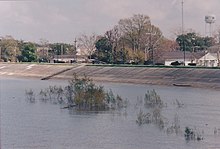
A levee keeps high water on the Mississippi River from flooding Gretna, Louisiana, in March 2005.
Prominent levee systems have been built forth the Mississippi River and Sacramento River in the Usa, and the Po, Rhine, Meuse River, Rhône, Loire, Vistula, the delta formed by the Rhine, Maas/Meuse and Scheldt in holland and the Danube in Europe. During the Chinese Warring States menstruum, the Dujiangyan irrigation system was built by the Qin as a water conservation and inundation control project. The organization's infrastructure is located on the Minjiang (Chinese: 岷江; pinyin: Mínjiāng ), which is the longest tributary of the Chang Jiang, in Sichuan, Cathay.
The Mississippi levee organization represents ane of the largest such systems found anywhere in the world. It comprises over 5,600 km (three,500 mi) of levees extending some 1,000 km (620 mi) along the Mississippi, stretching from Greatcoat Girardeau, Missouri, to the Mississippi delta. They were begun by French settlers in Louisiana in the 18th century to protect the city of New Orleans.[10] The starting time Louisiana levees were about ninety cm (3 ft) high and covered a distance of well-nigh fourscore km (fifty mi) along the riverside.[10] The U.S. Ground forces Corps of Engineers, in conjunction with the Mississippi River Commission, extended the levee system outset in 1882 to encompass the riverbanks from Cairo, Illinois to the mouth of the Mississippi delta in Louisiana.[10] By the mid-1980s, they had reached their present extent and averaged 7.3 yard (24 ft) in height; some Mississippi levees are as high as 15 m (fifty ft). The Mississippi levees also include some of the longest continuous individual levees in the world. One such levee extends southwards from Pino Bluff, Arkansas, for a distance of some 610 km (380 mi). The scope and scale of the Mississippi levees has often been compared to the Nifty Wall of China.[xi]
The United States Ground forces Corps of Engineers (USACE) recommends and supports cellular confinement engineering science (geocells) every bit a all-time management exercise.[12] Particular attending is given to the thing of surface erosion, overtopping prevention and protection of levee crest and downstream slope. Reinforcement with geocells provides tensile forcefulness to the soil to better resist instability.
Artificial levees can lead to an elevation of the natural river bed over time; whether this happens or not and how fast, depends on different factors, one of them beingness the corporeality and type of the bed load of a river. Alluvial rivers with intense accumulations of sediment tend to this behavior. Examples of rivers where artificial levees led to an elevation of the river bed, even up to a betoken where the river bed is higher than the adjacent footing surface backside the levees, are found for the Yellow River in Cathay and the Mississippi in the The states.
Coastal flood prevention [edit]
Levees are very common on the marshlands bordering the Bay of Fundy in New Brunswick and Nova Scotia, Canada. The Acadians who settled the expanse can be credited with the original construction of many of the levees in the area, created for the purpose of farming the fertile tidal marshlands. These levees are referred to every bit dykes. They are constructed with hinged sluice gates that open on the falling tide to bleed freshwater from the agronomical marshlands, and shut on the rising tide to prevent seawater from entering behind the dyke. These sluice gates are called "aboiteaux". In the Lower Mainland around the city of Vancouver, British Columbia, at that place are levees (known locally as dikes, and also referred to as "the sea wall") to protect low-lying land in the Fraser River delta, particularly the urban center of Richmond on Lulu Island. There are likewise dikes to protect other locations which have flooded in the by, such every bit the Pitt Polder, land adjacent to the Pitt River and other tributary rivers.
Coastal alluvion prevention levees are also common forth the inland coastline behind the Wadden Sea, an area devastated by many historic floods.[thirteen] Thus the peoples and governments have erected increasingly large and complex inundation protection levee systems to cease the body of water even during storm floods. The biggest of these are of course the huge levees in the Netherlands, which accept gone across but defending against floods, as they have aggressively taken dorsum state that is beneath mean bounding main level.[14]
Spur dykes or groynes [edit]
These typically man-made hydraulic structures are situated to protect confronting erosion. They are typically placed in alluvial rivers perpendicular, or at an angle, to the bank of the aqueduct or the revetment,[15] and are used widely forth coastlines. At that place are two common types of spur dyke, permeable and impermeable, depending on the materials used to construct them.
Natural examples [edit]
Natural levees commonly course around lowland rivers and creeks without human being intervention. They are elongate ridges of mud and/or silt that form on the river floodplains immediately side by side to the cut banks. Similar bogus levees, they act to reduce the likelihood of floodplain inundation.
Degradation of levees is a natural effect of the flooding of meandering rivers which carry loftier proportions of suspended sediment in the course of fine sands, silts, and muds. Considering the carrying capacity of a river depends in part on its depth, the sediment in the water which is over the flooded banks of the aqueduct is no longer capable of keeping the same amount of fine sediments in suspension as the main thalweg. The extra fine sediments thus settle out speedily on the parts of the floodplain nearest to the aqueduct. Over a significant number of floods, this will eventually result in the building upwards of ridges in these positions, and reducing the likelihood of farther floods and episodes of levee building.[sixteen]
If aggradation continues to occur in the main aqueduct, this will brand levee overtopping more probable again, and the levees can proceed to build upwards. In some cases this can outcome in the channel bed eventually ascension above the surrounding floodplains, penned in merely by the levees around it; an example is the Yellowish River in China near the ocean, where oceangoing ships appear to sail loftier above the obviously on the elevated river.[17]
Levees are mutual in whatever river with a loftier suspended sediment fraction, and thus are intimately associated with meandering channels, which also are more likely to occur where a river carries large fractions of suspended sediment. For similar reasons, they are also common in tidal creeks, where tides bring in large amounts of coastal silts and muds. Loftier jump tides volition cause flooding, and issue in the building up of levees.
Failures and breaches [edit]
Both natural and homo-made levees can neglect in a number of ways. Factors that cause levee failure include overtopping, erosion, structural failures, and levee saturation. The most frequent (and dangerous) is a levee breach. Here, a part of the levee really breaks or is eroded away, leaving a large opening for water to flood land otherwise protected by the levee. A alienation can be a sudden or gradual failure, caused either past surface erosion or by subsurface weakness in the levee. A breach can leave a fan-shaped deposit of sediment radiating abroad from the breach, described as a crevasse splay. In natural levees, once a breach has occurred, the gap in the levee will remain until information technology is again filled in past levee building processes. This increases the chances of future breaches occurring in the same location. Breaches can be the location of meander cutoffs if the river menses management is permanently diverted through the gap.
Sometimes levees are said to fail when water overtops the crest of the levee. This will cause flooding on the floodplains, just because information technology does not damage the levee, it has fewer consequences for futurity flooding.
Among various failure mechanisms that cause levee breaches, soil erosion is found to be one of the most important factors. Predicting soil erosion and scour generation when overtopping happens is important in guild to design stable levee and floodwalls. There accept been numerous studies to investigate the erodibility of soils. Briaud et al. (2008)[18] used Erosion Part Appliance (EFA) test to measure the erodibility of the soils and afterwards past using Chen 3D software, numerical simulations were performed on the levee to find out the velocity vectors in the overtopping water and the generated scour when the overtopping water impinges the levee. Past analyzing the results from EFA test, an erosion chart to categorize erodibility of the soils was developed. Hughes and Nadal in 2009[19] studied the event of combination of moving ridge overtopping and storm surge overflow on the erosion and scour generation in levees. The written report included hydraulic parameters and flow characteristics such as catamenia thickness, wave intervals, surge level above levee crown in analyzing scour development. Co-ordinate to the laboratory tests, empirical correlations related to average overtopping discharge were derived to analyze the resistance of levee against erosion. These equations could only fit to the situation, similar to the experimental tests, while they can give a reasonable interpretation if applied to other atmospheric condition.
Osouli et al. (2014) and Karimpour et al. (2015) conducted lab scale physical modeling of levees to evaluate score characterization of dissimilar levees due to floodwall overtopping.[20] [21]
Another approach practical to preclude levee failures is electrical resistivity tomography (ERT). This non-destructive geophysical method tin can observe in advance critical saturation areas in embankments. ERT tin can thus be used in monitoring of seepage phenomena in world structures and human action as an early warning system, e.g. in critical parts of levees or embankments.[22]
See also [edit]
- Bridge scour – Removal of sediment from around span abutments or piers by the movement of water
- Bunding – Retaining wall around pollution source
- Coupure – Structural feature
- Dam – Barrier that stops or restricts the flow of surface or undercover streams
- Earth structure – Building or other structure made largely from soil
- Embankment (earthworks) – Wall or banking concern to carry a route or rail over depression footing or h2o'due south edge
- Flood control – Methods used to reduce or prevent the detrimental effects of inundation waters
- Flood control in holland – Manmade command of flooding in holland
- Lava channel
- Nullah – Steep, narrow valley
- Seawall – Class of coastal defense force
- Sleeper dike – Dike that backs upwardly a front-line dike
- Subsidence – Downwards vertical movement of the Earth'due south surface
- Trench – Excavated channel in ground
Notes [edit]
- ^ "levee – meaning of levee in Longman Dictionary of Contemporary English". Ldoceonline.com.
- ^ "levee Significant in the Cambridge English Dictionary". Dictionary.cambridge.org.
- ^ Henry Petroski (2006). "Levees and Other Raised Ground". American Scientist. 94 (1): 7–11. doi:ten.1511/2006.57.seven.
- ^ "levee". Oxford English Dictionary (Online ed.). Oxford University Press. (Subscription or participating institution membership required.) 1718–1720: "Dumont Plan, New Orleans" [map characterization]. Shown in Justin Winsor, (1895) The Mississippi basin: The struggle in America between England and French republic 1697–1763. Boston; New York: Houghton, Mifflin and Company ISBN 0833747223. 1770: "The town [New Orleans] is secured from the inundations of the river by a raised banking company, generally called the Levée." Philip Pittman, The Present State of the European Settlements on the Mississippi; with a geographical clarification of that river. London
- ^ Tacitus Histories V xix
- ^ "Etymologisch woordenboek van het Nederlands, deel 1: A t/m E – Amsterdam Academy Press". Aup.nl.
- ^ "Weavers' Way footpath closure – Decoy Route (Hickling) to Potter Heigham 7 January 2011 – 6 April 2012". Countrysideaccess.norfolk.gov.britain. Retrieved 17 May 2013.
- ^ "Indus River Valley Civilizations". History-world.org. Archived from the original on 10 June 2012. Retrieved 12 September 2008.
{{cite spider web}}: CS1 maint: unfit URL (link) - ^ Needham, Joseph. (1971). Science and Civilisation in China: Volume four, Physics and Physical Technology, Part 3, Ceremonious Engineering and Nautics. Cambridge: Cambridge University Press; Brian Lander. "State Management of River Dikes in Early on Prc: New Sources on the Environmental History of the Central Yangzi Region." T'oung Pao 100.four–5 (2014): 325–62.
- ^ a b c Kemp, Katherine. The Mississippi Levee System and the Old River Command ConstructionThe Louisiana Environs. Tulane.edu
- ^ McPhee, John (23 February 1987). "The Control of Nature: Atchafalaya". The New Yorker. Archived from the original on 13 May 2011. Retrieved 12 May 2011. Republished in McPhee, John (1989). The Control of Nature. Farrar, Straus and Giroux. p. 272. ISBN0-374-12890-1.
- ^ Edward B. Perry (September 1998). "levee rehabilitation in USACE Technical Report REMR-GT-26, Innovative Methods for Levee Rehabilitation" (PDF). Dtic.mil. Archived from the original on 8 Apr 2013. Retrieved three April 2019.
- ^ "Trilateral Working Grouping on Coastal Protection and Sea Level Rise (CPSL), Wadden Ocean Ecosystem No. 25 past Jacobus Hofstede, Common Wadden Sea Secretariat (CWSS), Wilhelmshaven, Germany, 2009" (PDF). Waddensea-secretariat.org. Archived (PDF) from the original on 9 October 2022. Retrieved 3 Apr 2019.
- ^ Matt Rosenberg. "Dikes of the Netherlands — Geography". Geography.nigh.com.
- ^ "Hao Zhang, Hajime Nakagawa, 2008, Scour around Spur Dyke: Recent Advances and Hereafter Researches" (PDF). Dpri.kyoto-u.ac.jp. Archived (PDF) from the original on ix October 2022. Retrieved 17 May 2013.
- ^ Leeder, M. R. (2011). Sedimentology and sedimentary basins : from turbulence to tectonics (2nd ed.). Chichester, West Sussex, United kingdom of great britain and northern ireland: Wiley-Blackwell. pp. 265–266. ISBN9781405177832.
- ^ Leeder 2011, pp. 269–271.
- ^ Briaud, J., Chen, H., Govindasamy, A., Storesund, R. (2008). Levee erosion by overtopping in New Orleans during the Katrina Hurricane. Journal of Geotechnical and Geoenvironmental Engineering. 134 (five): 618–632.
- ^ Hughes, South.A., Nadal, Northward.C. (2009). Laboratory written report of combined moving ridge overtopping and storm surge overflow of a levee. Coastal Engineering science.56: 244–259
- ^ Karimpour, Mazdak; Heinzl, Kyle; Stendback, Emaline; Galle, Kevin; Zamiran, Siavash; Osouli, Abdolreza (2015). "Scour Characteristics of Saturated Levees Due to Floodwall Overtopping". IFCEE 2015. pp. 1298–1307. doi:10.1061/9780784479087.117. ISBN9780784479087.
- ^ "Levee Erosion and Scour Potential Due to Floodwall Overtopping (PDF Download Available)". ResearchGate.
- ^ Arosio, Diego; Munda, Stefano; Tresoldi, Greta; Papini, Monica; Longoni, Laura; Zanzi, Luigi (13 Oct 2017). "A customized resistivity system for monitoring saturation and seepage in earthen levees: installation and validation". Open Geosciences. 9 (1): 457–467. Bibcode:2017OGeo....9...35A. doi:10.1515/geo-2017-0035. ISSN 2391-5447.
External links [edit]

Wikimedia Eatables has media related to Dikes.
- "Well Diggers Trick", June 1951, Pop Science article on how flood control engineers were using an one-time method to protect alluvion levees along rivers from seepage undermining the levee
- "Design and Construction of Levees" Usa Army Engineer Transmission EM-1110-2-1913
- The International Levee Handbook

A Natural Levee Is ________.,
Source: https://en.wikipedia.org/wiki/Levee
Posted by: jonesthathathe.blogspot.com
0 Response to "A Natural Levee Is ________."
Post a Comment