

Total Energy Of A Spring
Learning Objectives
By the end of this department, you volition exist able to:
- Depict the energy conservation of the system of a mass and a jump
- Explain the concepts of stable and unstable equilibrium points
To produce a deformation in an object, nosotros must practise work. That is, whether you pluck a guitar string or shrink a automobile'due south shock absorber, a force must be exerted through a distance. If the only outcome is deformation, and no work goes into thermal, sound, or kinetic energy, and then all the work is initially stored in the deformed object every bit some class of potential energy.
Consider the case of a cake attached to a bound on a frictionless table, aquiver in SHM. The strength of the bound is a conservative strength (which you studied in the affiliate on potential free energy and conservation of energy), and nosotros can define a potential energy for information technology. This potential free energy is the energy stored in the bound when the spring is extended or compressed. In this case, the block oscillates in 1 dimension with the strength of the spring acting parallel to the motion:
[latex] W=\underset{{ten}_{i}}{\overset{{x}_{f}}{\int }}{F}_{10}dx=\underset{{x}_{i}}{\overset{{ten}_{f}}{\int }}\text{−}kxdx={[-\frac{1}{two}k{x}^{2}]}_{{ten}_{i}}^{{x}_{f}}=\text{−}[\frac{1}{2}g{x}_{f}^{two}-\frac{1}{2}thousand{x}_{i}^{2}]=\text{−}[{U}_{f}-{U}_{i}]=\text{−}\text{Δ}U. [/latex]
When considering the energy stored in a spring, the equilibrium position, marked every bit [latex] {x}_{i}=0.00\,\text{m,} [/latex] is the position at which the energy stored in the jump is equal to zero. When the spring is stretched or compressed a distance 10, the potential free energy stored in the spring is
[latex] U=\frac{1}{2}k{x}^{two}. [/latex]
Energy and the Simple Harmonic Oscillator
To study the energy of a unproblematic harmonic oscillator, nosotros need to consider all the forms of energy. Consider the example of a block fastened to a spring, placed on a frictionless surface, aquiver in SHM. The potential energy stored in the deformation of the bound is
[latex] U=\frac{1}{two}k{x}^{2}. [/latex]
In a simple harmonic oscillator , the energy oscillates between kinetic free energy of the mass [latex] K=\frac{1}{2}m{v}^{2} [/latex] and potential energy [latex] U=\frac{ane}{2}k{x}^{ii} [/latex] stored in the spring. In the SHM of the mass and spring system, there are no dissipative forces, and so the total free energy is the sum of the potential free energy and kinetic energy. In this section, we consider the conservation of energy of the organization. The concepts examined are valid for all simple harmonic oscillators, including those where the gravitational force plays a role.
Consider (Effigy), which shows an aquiver block attached to a spring. In the instance of undamped SHM, the free energy oscillates back and forth between kinetic and potential, going completely from one grade of energy to the other every bit the system oscillates. And so for the elementary example of an object on a frictionless surface attached to a spring, the movement starts with all of the free energy stored in the leap as elastic potential energy. As the object starts to move, the elastic potential energy is converted into kinetic energy, becoming entirely kinetic energy at the equilibrium position. The free energy is then converted back into elastic potential free energy by the spring as information technology is stretched or compressed. The velocity becomes aught when the kinetic energy is completely converted, and this cycle so repeats. Understanding the conservation of free energy in these cycles will provide extra insight here and in later applications of SHM, such as alternating circuits.
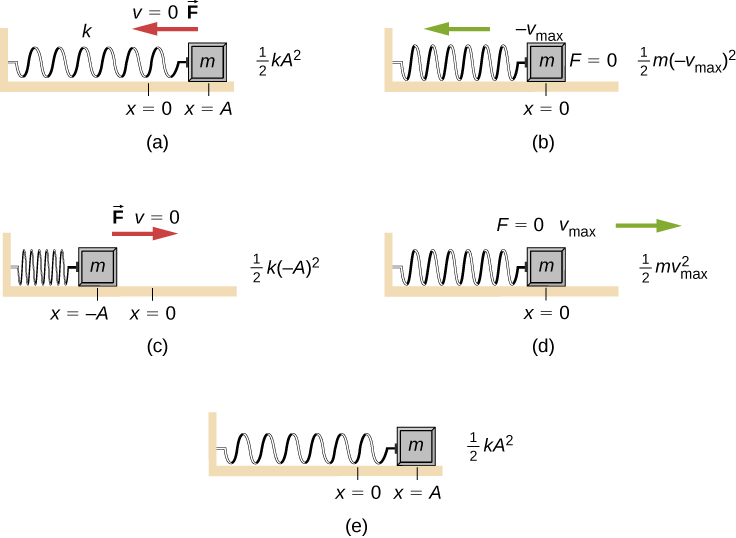
Figure xv.x The transformation of free energy in SHM for an object fastened to a spring on a frictionless surface. (a) When the mass is at the position [latex] x=+A [/latex], all the energy is stored equally potential energy in the bound [latex] U=\frac{1}{2}thou{A}^{2} [/latex]. The kinetic energy is equal to zero considering the velocity of the mass is zero. (b) Equally the mass moves toward [latex] x=\text{−}A [/latex], the mass crosses the position [latex] ten=0 [/latex]. At this point, the spring is neither extended nor compressed, then the potential energy stored in the spring is zip. At [latex] x=0 [/latex], the total free energy is all kinetic energy where [latex] K=\frac{1}{2}m{(\text{−}{5}_{\text{max}})}^{2} [/latex]. (c) The mass continues to move until information technology reaches [latex] 10=\text{−}A [/latex] where the mass stops and starts moving toward [latex] x=+A [/latex]. At the position [latex] x=\text{−}A [/latex], the total energy is stored as potential energy in the compressed [latex] U=\frac{one}{two}k{(\text{−}A)}^{2} [/latex] and the kinetic energy is zero. (d) Equally the mass passes through the position [latex] x=0 [/latex], the kinetic free energy is [latex] K=\frac{one}{ii}m{5}_{\text{max}}^{two} [/latex] and the potential free energy stored in the spring is zero. (e) The mass returns to the position [latex] x=+A [/latex], where [latex] K=0 [/latex] and [latex] U=\frac{i}{ii}thou{A}^{two} [/latex].
Consider (Effigy), which shows the energy at specific points on the periodic motion. While staying constant, the energy oscillates between the kinetic free energy of the block and the potential free energy stored in the spring:
[latex] {E}_{\text{Total}}=U+K=\frac{1}{2}k{x}^{ii}+\frac{one}{two}1000{five}^{two}. [/latex]
The motility of the cake on a spring in SHM is defined past the position [latex] ten(t)=A\text{cos}(\omega t+\varphi ) [/latex] with a velocity of [latex] v(t)=\text{−}A\omega \text{sin}(\omega t+\varphi ) [/latex]. Using these equations, the trigonometric identity [latex] {\text{cos}}^{2}\theta +{\text{sin}}^{2}\theta =1 [/latex] and [latex] \omega =\sqrt{\frac{thou}{one thousand}} [/latex], nosotros tin notice the total energy of the system:
[latex] \begin{assortment}{cc}\hfill {E}_{\text{Total}}& =\frac{i}{ii}k{A}^{2}{\text{cos}}^{2}(\omega t+\varphi )+\frac{1}{2}k{A}^{2}{\omega }^{ii}{\text{sin}}^{two}(\omega t+\varphi )\hfill \\ & =\frac{1}{2}yard{A}^{2}{\text{cos}}^{ii}(\omega t+\varphi )+\frac{1}{2}m{A}^{2}(\frac{k}{1000}){\text{sin}}^{2}(\omega t+\varphi )\hfill \\ & =\frac{1}{two}k{A}^{2}{\text{cos}}^{2}(\omega t+\varphi )+\frac{1}{ii}k{A}^{ii}{\text{sin}}^{2}(\omega t+\varphi )\hfill \\ & =\frac{one}{2}chiliad{A}^{2}({\text{cos}}^{two}(\omega t+\varphi )+{\text{sin}}^{ii}(\omega t+\varphi ))\hfill \\ & =\frac{1}{2}thousand{A}^{2}.\hfill \stop{array} [/latex]
The total energy of the arrangement of a cake and a leap is equal to the sum of the potential free energy stored in the jump plus the kinetic energy of the cake and is proportional to the square of the amplitude [latex] {E}_{\text{Total}}=(1\text{/}ii)k{A}^{2}. [/latex] The total free energy of the system is constant.
A closer look at the energy of the system shows that the kinetic free energy oscillates like a sine-squared function, while the potential energy oscillates like a cosine-squared office. Even so, the total energy for the organisation is constant and is proportional to the amplitude squared. (Figure) shows a plot of the potential, kinetic, and total energies of the block and spring system as a office of time. As well plotted are the position and velocity equally a role of fourth dimension. Before time [latex] t=0.0\,\text{s,} [/latex] the block is attached to the leap and placed at the equilibrium position. Work is washed on the block by applying an external force, pulling it out to a position of [latex] x=+A [/latex]. The system now has potential energy stored in the bound. At fourth dimension [latex] t=0.00\,\text{southward,} [/latex] the position of the cake is equal to the aamplitude, the potential energy stored in the spring is equal to [latex] U=\frac{1}{2}chiliad{A}^{2} [/latex], and the forcefulness on the block is maximum and points in the negative x-direction [latex] ({F}_{S}=\text{−}kA) [/latex]. The velocity and kinetic energy of the block are nada at time [latex] t=0.00\,\text{s}\text{.} [/latex] At time [latex] t=0.00\,\text{southward,} [/latex] the block is released from balance.
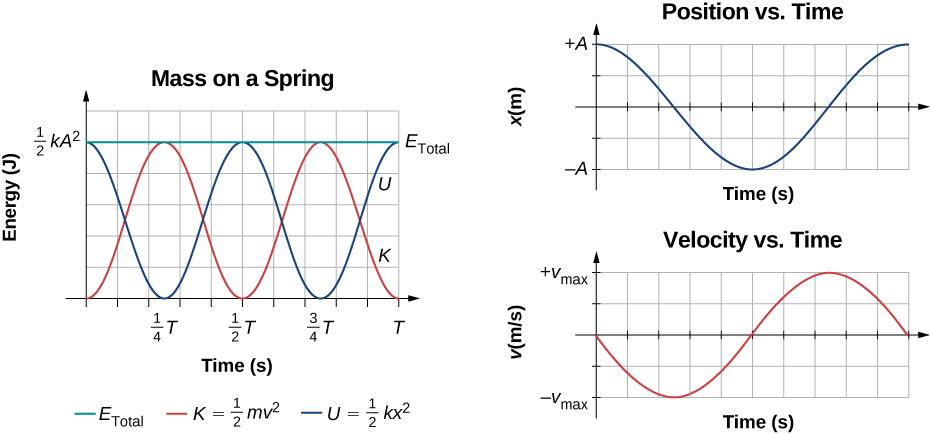
Figure fifteen.12 Graph of the kinetic energy, potential energy, and full free energy of a block oscillating on a spring in SHM. As well shown are the graphs of position versus time and velocity versus fourth dimension. The total energy remains abiding, merely the energy oscillates betwixt kinetic energy and potential energy. When the kinetic energy is maximum, the potential energy is zero. This occurs when the velocity is maximum and the mass is at the equilibrium position. The potential free energy is maximum when the speed is zero. The total energy is the sum of the kinetic energy plus the potential energy and information technology is constant.
Oscillations About an Equilibrium Position
We accept just considered the energy of SHM as a function of time. Another interesting view of the simple harmonic oscillator is to consider the energy every bit a function of position. (Figure) shows a graph of the energy versus position of a system undergoing SHM.
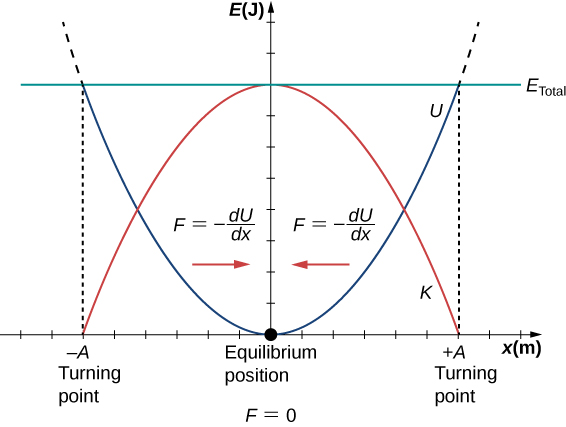
Figure 15.13 A graph of the kinetic energy (blood-red), potential free energy (blue), and total energy (light-green) of a simple harmonic oscillator. The force is equal to [latex] F=-\frac{dU}{dx} [/latex]. The equilibrium position is shown every bit a black dot and is the signal where the force is equal to zero. The strength is positive when [latex] x<0 [/latex], negative when [latex] x>0 [/latex], and equal to naught when [latex] x=0 [/latex].
The potential energy curve in (Figure) resembles a bowl. When a marble is placed in a bowl, it settles to the equilibrium position at the everyman indicate of the bowl [latex] (10=0) [/latex]. This happens because a restoring force points toward the equilibrium point. This equilibrium indicate is sometimes referred to as a stock-still point. When the marble is disturbed to a different position [latex] (x=+A) [/latex], the marble oscillates effectually the equilibrium position. Looking back at the graph of potential energy, the strength tin be institute past looking at the slope of the potential energy graph [latex] (F=-\frac{dU}{dx}) [/latex]. Since the force on either side of the fixed point points back toward the equilibrium point, the equilibrium point is chosen a stable equilibrium betoken. The points [latex] 10=A [/latex] and [latex] x=\text{−}A [/latex] are chosen the turning points. (See Potential Energy and Conservation of Free energy.)
Stability is an important concept. If an equilibrium indicate is stable, a slight disturbance of an object that is initially at the stable equilibrium betoken volition cause the object to oscillate around that point. The stable equilibrium point occurs because the strength on either side is directed toward information technology. For an unstable equilibrium point, if the object is disturbed slightly, information technology does not render to the equilibrium point.
Consider the marble in the bowl case. If the bowl is right-side upwards, the marble, if disturbed slightly, will oscillate around the stable equilibrium point. If the bowl is turned upside down, the marble tin exist counterbalanced on the top, at the equilibrium signal where the net force is zippo. However, if the marble is disturbed slightly, it will not return to the equilibrium point, but will instead roll off the basin. The reason is that the force on either side of the equilibrium betoken is directed away from that point. This point is an unstable equilibrium signal.
(Figure) shows iii atmospheric condition. The first is a stable equilibrium bespeak (a), the second is an unstable equilibrium point (b), and the concluding is also an unstable equilibrium point (c), considering the forcefulness on only one side points toward the equilibrium point.
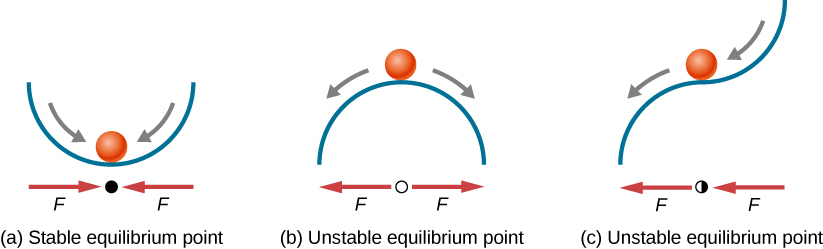
Figure xv.xiv Examples of equilibrium points. (a) Stable equilibrium indicate; (b) unstable equilibrium point; (c) unstable equilibrium point (sometimes referred to as a half-stable equilibrium point).
The process of determining whether an equilibrium point is stable or unstable tin can exist formalized. Consider the potential energy curves shown in (Figure). The force tin be found past analyzing the slope of the graph. The strength is [latex] F=-\frac{dU}{dx}. [/latex] In (a), the stock-still point is at [latex] x=0.00\,\text{m}\text{.} [/latex] When [latex] 10<0.00\,\text{thou,} [/latex] the force is positive. When [latex] ten>0.00\,\text{grand,} [/latex] the strength is negative. This is a stable point. In (b), the fixed point is at [latex] x=0.00\,\text{thousand}\text{.} [/latex] When [latex] ten<0.00\,\text{m,} [/latex] the force is negative. When [latex] x>0.00\,\text{m,} [/latex] the force is besides negative. This is an unstable point.
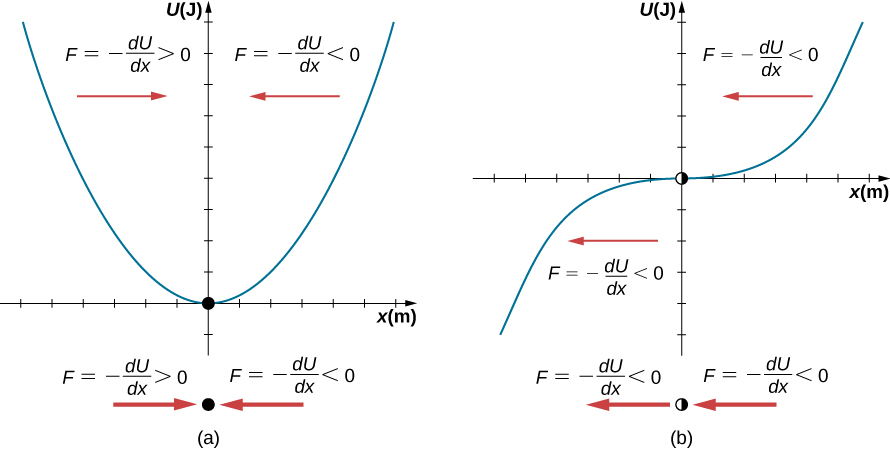
Figure 15.fifteen Two examples of a potential free energy part. The forcefulness at a position is equal to the negative of the slope of the graph at that position. (a) A potential free energy part with a stable equilibrium betoken. (b) A potential energy role with an unstable equilibrium point. This point is sometimes called half-stable because the strength on one side points toward the fixed point.
A practical application of the concept of stable equilibrium points is the forcefulness betwixt two neutral atoms in a molecule. If two molecules are in close proximity, separated by a few diminutive diameters, they can experience an attractive forcefulness. If the molecules motility close plenty then that the electron shells of the other electrons overlap, the strength between the molecules becomes repulsive. The bonny force between the ii atoms may cause the atoms to form a molecule. The strength betwixt the two molecules is not a linear strength and cannot be modeled simply every bit two masses separated past a bound, simply the atoms of the molecule can oscillate around an equilibrium point when displaced a small corporeality from the equilibrium position. The atoms oscillate due the attractive force and repulsive force between the 2 atoms.
Consider one example of the interaction between two atoms known equally the van Der Waals interaction. It is beyond the scope of this chapter to discuss in depth the interactions of the two atoms, simply the oscillations of the atoms can be examined past considering ane example of a model of the potential energy of the system. One suggestion to model the potential energy of this molecule is with the Lennard-Jones half dozen-12 potential:
[latex] U(x)=4\epsilon [{(\frac{\sigma }{x})}^{12}-{(\frac{\sigma }{10})}^{6}]. [/latex]
A graph of this office is shown in (Figure). The two parameters [latex] \epsilon [/latex] and [latex] \sigma [/latex] are constitute experimentally.
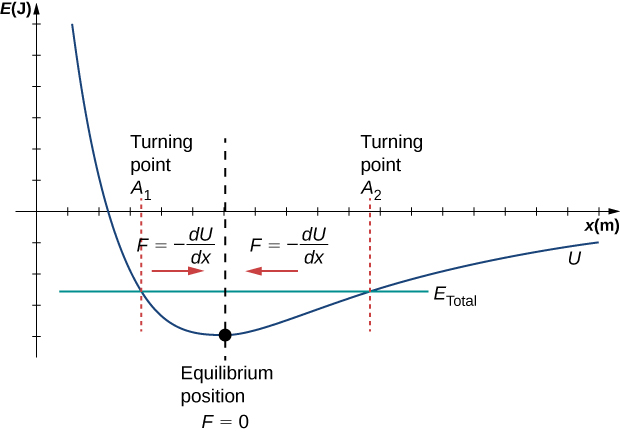
Figure 15.xvi The Lennard-Jones potential energy part for a system of two neutral atoms. If the energy is below some maximum free energy, the arrangement oscillates near the equilibrium position between the ii turning points.
From the graph, you tin can meet that there is a potential energy well, which has some similarities to the potential energy well of the potential free energy role of the simple harmonic oscillator discussed in (Figure). The Lennard-Jones potential has a stable equilibrium point where the potential energy is minimum and the force on either side of the equilibrium point points toward equilibrium betoken. Note that dissimilar the simple harmonic oscillator, the potential well of the Lennard-Jones potential is non symmetric. This is due to the fact that the forcefulness betwixt the atoms is non a Hooke's law forcefulness and is not linear. The atoms tin still oscillate around the equilibrium position [latex] {x}_{\text{min}} [/latex] because when [latex] x<{x}_{\text{min}} [/latex], the force is positive; when [latex] ten>{10}_{\text{min}} [/latex], the force is negative. Detect that as ten approaches cipher, the slope is quite steep and negative, which means that the forcefulness is large and positive. This suggests that it takes a large force to effort to push the atoms close together. As x becomes increasingly large, the slope becomes less steep and the force is smaller and negative. This suggests that if given a large plenty energy, the atoms tin can exist separated.
If you are interested in this interaction, find the force between the molecules by taking the derivative of the potential energy office. You will encounter immediately that the force does not resemble a Hooke's constabulary force [latex] (F=\text{−}kx) [/latex], but if you are familiar with the binomial theorem:
[latex] {(1+ten)}^{due north}=i+nx+\frac{due north(due north-one)}{two!}{ten}^{2}+\frac{n(due north-1)(due north-ii)}{3!}{x}^{3}+\cdots , [/latex]
the force can exist approximated by a Hooke's law force.
Velocity and Energy Conservation
Getting back to the system of a cake and a spring in (Figure), once the block is released from rest, it begins to movement in the negative direction toward the equilibrium position. The potential free energy decreases and the magnitude of the velocity and the kinetic energy increment. At fourth dimension [latex] t=T\text{/}iv [/latex], the cake reaches the equilibrium position [latex] 10=0.00\,\text{thousand,} [/latex] where the forcefulness on the block and the potential energy are zero. At the equilibrium position, the block reaches a negative velocity with a magnitude equal to the maximum velocity [latex] 5=\text{−}A\omega [/latex]. The kinetic energy is maximum and equal to [latex] G=\frac{1}{2}g{v}^{ii}=\frac{1}{ii}k{A}^{2}{\omega }^{2}=\frac{one}{2}grand{A}^{2}. [/latex] At this signal, the force on the block is zero, merely momentum carries the block, and it continues in the negative direction toward [latex] x=\text{−}A [/latex]. As the cake continues to move, the force on information technology acts in the positive direction and the magnitude of the velocity and kinetic energy decrease. The potential energy increases as the spring compresses. At time [latex] t=T\text{/}ii [/latex], the block reaches [latex] 10=\text{−}A [/latex]. Here the velocity and kinetic energy are equal to zero. The force on the block is [latex] F=+kA [/latex] and the potential energy stored in the spring is [latex] U=\frac{1}{2}k{A}^{ii} [/latex]. During the oscillations, the total energy is constant and equal to the sum of the potential energy and the kinetic energy of the arrangement,
[latex] {East}_{\text{Full}}=\frac{1}{2}chiliad{10}^{2}+\frac{1}{2}m{v}^{2}=\frac{one}{two}m{A}^{2}. [/latex]
The equation for the energy associated with SHM can be solved to find the magnitude of the velocity at any position:
[latex] |v|=\sqrt{\frac{k}{one thousand}({A}^{2}-{10}^{2})}. [/latex]
The energy in a uncomplicated harmonic oscillator is proportional to the square of the amplitude. When because many forms of oscillations, y'all will find the energy proportional to the aamplitude squared.
Check Your Agreement
Why would it hurt more if you snapped your hand with a ruler than with a loose spring, even if the displacement of each system is equal?
Show Solution
The ruler is a stiffer arrangement, which carries greater force for the same amount of deportation. The ruler snaps your hand with greater force, which hurts more than.
Check Your Understanding
Identify one way you could decrease the maximum velocity of a elementary harmonic oscillator.
Show Solution
You could increase the mass of the object that is oscillating. Other options would be to reduce the amplitude, or use a less stiff jump.
Summary
- The simplest type of oscillations are related to systems that can exist described by Hooke'southward law, F = −kx, where F is the restoring force, x is the displacement from equilibrium or deformation, and k is the force constant of the system.
- Elastic potential energy U stored in the deformation of a system that tin exist described past Hooke's law is given by[latex] U=\frac{one}{ii}k{ten}^{2}. [/latex]
- Energy in the simple harmonic oscillator is shared between elastic potential energy and kinetic energy, with the total existence constant:
[latex] {East}_{\text{Total}}=\frac{1}{2}k{5}^{2}+\frac{1}{2}thousand{x}^{2}=\frac{one}{2}k{A}^{ii}=\text{abiding.} [/latex]
- The magnitude of the velocity equally a function of position for the simple harmonic oscillator can be found by using
[latex] |v|=\sqrt{\frac{k}{thousand}({A}^{2}-{10}^{two})}. [/latex]
Conceptual Questions
Describe a arrangement in which elastic potential energy is stored.
Prove Solution
In a automobile, elastic potential energy is stored when the stupor is extended or compressed. In some running shoes elastic potential energy is stored in the compression of the material of the soles of the running shoes. In pole vaulting, elastic potential energy is stored in the bending of the pole.
Explain in terms of energy how dissipative forces such as friction reduce the amplitude of a harmonic oscillator. Also explain how a driving mechanism tin can recoup. (A pendulum clock is such a system.)
The temperature of the atmosphere oscillates from a maximum near noontime and a minimum nigh sunrise. Would you consider the atmosphere to exist in stable or unstable equilibrium?
Show Solution
The overall system is stable. At that place may be times when the stability is interrupted past a tempest, but the driving forcefulness provided by the sun bring the temper back into a stable pattern.
Problems
Fish are hung on a jump scale to determine their mass. (a) What is the strength constant of the spring in such a scale if it the spring stretches 8.00 cm for a 10.0 kg load? (b) What is the mass of a fish that stretches the spring 5.fifty cm? (c) How far apart are the half-kilogram marks on the scale?
It is weigh-in time for the local under-85-kg rugby team. The bath calibration used to assess eligibility can be described past Hooke'south constabulary and is depressed 0.75 cm by its maximum load of 120 kg. (a) What is the spring's effective force constant? (b) A player stands on the scales and depresses it by 0.48 cm. Is he eligible to play on this under-85-kg team?
Show Solution
a. [latex] ane.57\,×\,{10}^{5}\,\text{North/grand} [/latex]; b. 77 kg, yes, he is eligible to play
1 type of BB gun uses a spring-driven plunger to blow the BB from its barrel. (a) Calculate the force constant of its plunger'due south leap if yous must shrink it 0.150 m to bulldoze the 0.0500-kg plunger to a top speed of twenty.0 one thousand/s. (b) What forcefulness must be exerted to shrink the bound?
When an fourscore.0-kg human stands on a pogo stick, the jump is compressed 0.120 1000. (a) What is the force abiding of the spring? (b) Will the spring exist compressed more than when he hops downwardly the road?
Evidence Solution
a. [latex] 6.53\,×\,{10}^{3}\,\text{N/m} [/latex]; b. aye, when the man is at his lowest point in his hopping the leap will be compressed the most
A jump has a length of 0.200 m when a 0.300-kg mass hangs from information technology, and a length of 0.750 m when a 1.95-kg mass hangs from it. (a) What is the force abiding of the spring? (b) What is the unloaded length of the spring?
The length of nylon rope from which a mount climber is suspended has an effective force constant of [latex] ane.forty\,×\,{10}^{4}\,\text{N/grand} [/latex]. (a) What is the frequency at which he bounces, given his mass plus and the mass of his equipment are 90.0 kg? (b) How much would this rope stretch to break the climber's autumn if he costless-falls 2.00 m before the rope runs out of slack? (Hint: Use conservation of energy.) (c) Repeat both parts of this problem in the situation where twice this length of nylon rope is used.
Show Solution
a. 1.99 Hz; b. 50.ii cm; c. 0.710 k
Glossary
- rubberband potential energy
- potential energy stored every bit a result of deformation of an elastic object, such as the stretching of a spring
- restoring force
- strength interim in opposition to the force acquired by a deformation
- stable equilibrium bespeak
- point where the net force on a arrangement is nothing, simply a minor displacement of the mass will crusade a restoring force that points toward the equilibrium point

Total Energy Of A Spring,
Source: https://courses.lumenlearning.com/suny-osuniversityphysics/chapter/15-2-energy-in-simple-harmonic-motion/
Posted by: jonesthathathe.blogspot.com
0 Response to "Total Energy Of A Spring"
Post a Comment